
Explainer
Long-distance caregiving, without cameras in their home
 By Dsign Digital Technologies, makers of Tadu RemoteUpdated October 2026
The dignity-first alternative to room cameras: help with the appliance they actually use, with their consent every time.
The short answer
You do not need a camera in your parents’ living room to help them from far away. Most of what long-distance families actually do (fixing the TV, getting a message through, showing photos, timed reminders, a one-press way to ask for help) can happen through the TV they already own, with their consent on their own screen each time and nothing observed or recorded in between.
What is the camera bargain, stated honestly?
A surprising amount of “aging in place” technology asks families to accept the same trade: to help your parent, put a device in their home that can see or hear them. Room cameras, video check-ins you can open “anytime”, sensors that report movement. The pitch is reassurance for you. The price is paid by your parent: a lens in the room where they live, and a relationship quietly reframed from helped to watched.
Many parents accept it because they don’t want to be a burden. Many families install it and feel a low-grade unease they can’t name. It is worth naming: most families don’t actually need observation. They need reachability, the ability to act at the moment help is wanted.
What do you actually need, most weeks?
Write down the last five times you worried about a far-away parent, and the list usually looks like this:
- The TV “broke” (an app froze, an app signed out) and the evening stalled.
- The phone rang unanswered and your mind went to dark places (they were watching a serial, volume up).
- A medicine or an appointment needed remembering at the right hour, not during the morning call.
- They needed help but didn’t want to “bother” anyone, so you found out days later.
- You wanted to share something better than a phone screen allows: the grandchild’s play, the new flat.
Not one of those requires watching anyone. Every one of them runs through the appliance your parent already faces for hours a day: the television.

How is the TV the care surface?
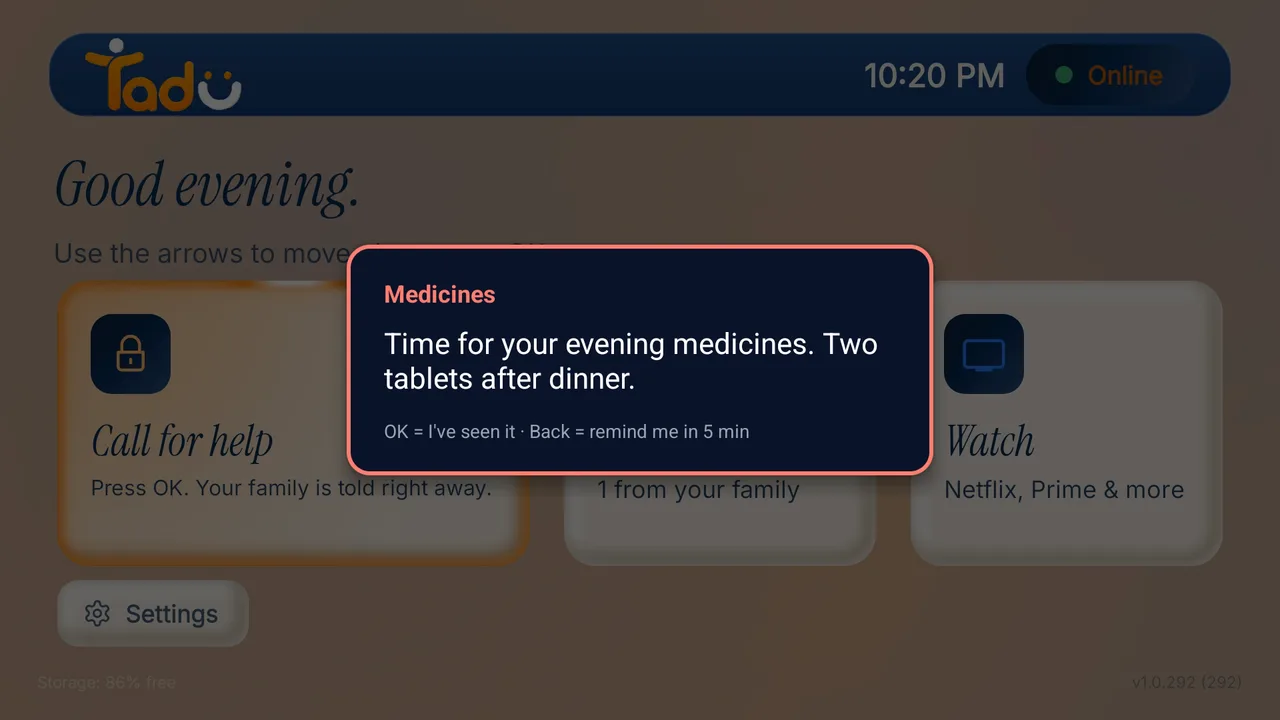
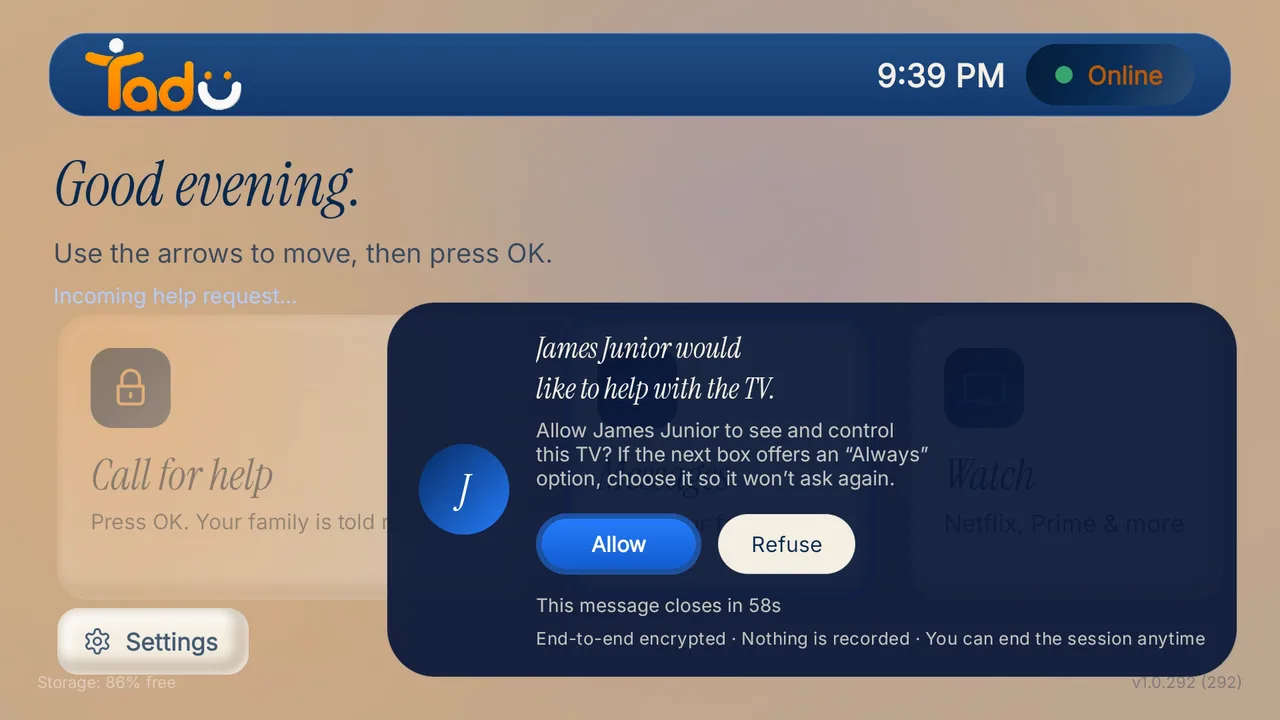
Consent-first TV care handles that whole list without a camera. When the TV misbehaves, you connect from your phone: their TV shows who is asking, they press OK on their own remote, and you see their screen live and fix it. The stream is encrypted and never recorded, so there is nothing to replay later. When the phone goes unanswered, a short message lands on the TV they are actually watching. Photos are presented live on the biggest screen in the house. A reminder (a note, a photo, or both) appears at the hour it matters, and you are told when they pressed OK. And a one-press Call for help on their TV rings the whole family, so asking for help stops feeling like bothering someone.
The parent stays the decision-maker in every one of those moments. That is not a limitation of the model. It is the point of it.
When is monitoring the right choice?
Honesty requires the other half: sometimes observation is the loving choice. Faced with advanced dementia, a serious fall history, or a clinician’s recommendation, families may rightly choose cameras or sensors, openly, with the parent or their lawful guardian in the decision. If that is your situation, choose a monitoring product deliberately and name it for what it is.
What deserves resistance is monitoring by default: a camera that arrives bundled with the TV helper, observation as the price of assistance. Ask any product in this space one question: can the family look or listen without the parent saying yes at that moment? If the answer is yes, it is a monitoring product, whatever the brochure calls it.
What is the checklist for camera-free care?
- 01 / Check
No lens, no microphone in the room
The TV streams its own screen during approved sessions; nothing watches the sofa, and the TV app has no audio permission. - 02 / Check
Consent on their screen, every time
Name and photo of who is asking; one press to accept; no answer means no. - 03 / Check
Nothing recorded from the home
Live, encrypted streams only. (A photo the family attaches to a reminder is stored encrypted so it can show on the TV, and deleted when they delete it. That is stored for the family, never captured from the home.) - 04 / Check
Works across any two networks
Another city or another country must behave the same as the next room. - 05 / Check
Nothing for the parent to learn
Their side is the TV they already watch and the remote they already hold.
Tadu Remote is built to pass this checklist on Fire TV, Google TV and Android TV; it is the product this site describes. But the checklist stands on its own: hold anything you consider, including ours, against it.
Can I help my elderly parent from far away without installing cameras?
Yes. Most of what long-distance families actually need (fixing the TV when it breaks, getting a message through when the phone goes unanswered, showing photos, timed reminders, a one-press way for the parent to ask for help) can be done through the TV the parent already owns, with their Allow on the TV for every screen-sharing session and no camera anywhere in the home.
What is the difference between caregiving technology and monitoring technology?
Monitoring technology observes the parent: cameras, sensors, check-ins the family initiates whenever they choose. Caregiving technology assists the parent: it acts only when the parent accepts help on their own screen, and it observes nothing in between. The practical test: can the family look in without the parent saying yes at that moment? If so, it is monitoring.
Is a room camera ever the right choice for an aging parent?
Sometimes. Advanced dementia, serious fall risk, or a clinician’s advice can make deliberate monitoring the loving choice. The key word is deliberate: it should be chosen openly with the parent or their lawful guardian, as its own decision, not arrive as a side effect of a TV gadget. Families who need monitoring should buy monitoring; families who need help should not have to accept a camera to get it.
How does consent-first TV help work technically?
An app on the parent's Fire TV, Google TV or Android TV connects to the helper's phone over the internet, across any two networks, wherever the app is available. When the helper asks to see the screen, the TV shows who is asking and the parent approves with one press of their own remote. The session is an encrypted live stream that is never recorded; when it ends, nothing exists to replay.

Keep reading
Related guides
Explainer
What is Remote Family TV Care?
The category, defined: consent-first, cross-network help with the TV a parent already owns, and how it differs from remote desktop, hardware hubs and monitoring products.
Read the guide →October 2026

How-to
Medication reminders, on the screen they actually watch
Phone alarms get silenced; pillboxes stay in drawers. How family-set reminders on a parent’s TV work (text or photo, OK to confirm, Back to see it again) and their honest limits.
Read the guide →October 2026
Setup
Set up Tadu Remote on a Fire TV
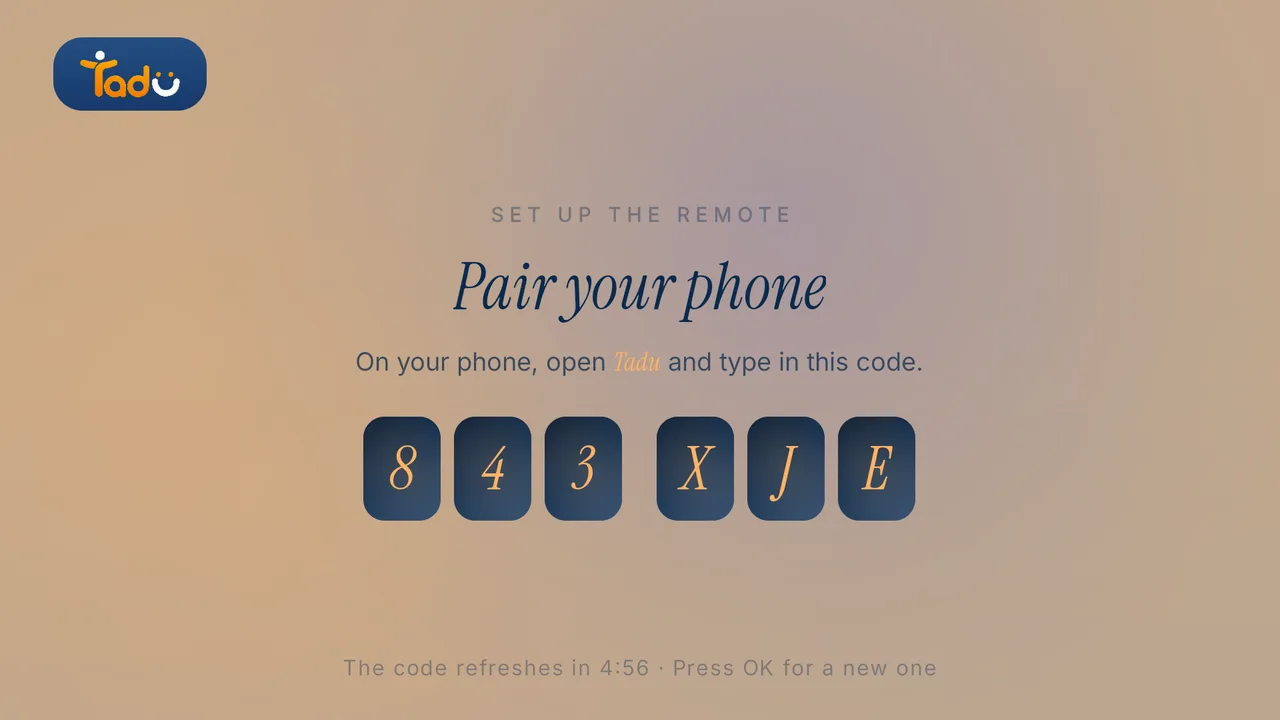
Install the free TV app, type the 6-character code into your phone, link the remote with Amazon’s 4-digit code and turn on screen sharing. Every screen your parent will see.
Read the guide →October 2026